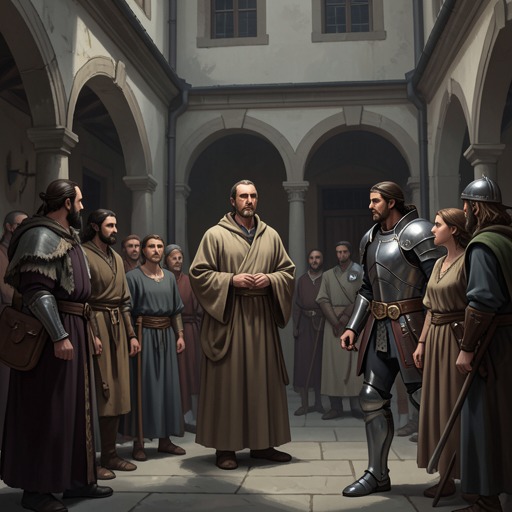
Duel between Duan Yanqing and Duan Zhengchun at Little Mirror Lake
Demi-Gods and Semi-DevilsThe Duel between Duan Yanqing and Duan Zhengchun at Little Mirror Lake is a contest over the Dali throne staged as a one-on-one family combat. Duan Zhengchun insists that the struggle is between the two of them alone and that his followers and family should be spared; Duan Yanqing accepts the terms but seeks to defeat him with the Duan family’s own orthodox martial arts, giving his bid for the throne a politically defensible form. The fight ends not with a victor’s claim but with Xiao Feng pulling Duan Zhengchun out of the path of a fatal blow, an intervention driven by Xiao Feng’s own grievance against him.
Causes and Stakes
Duan Zhengchun has just witnessed the death of Chu Wanli and is distressed and ashamed of his daughter. He puts away his sword, approaches Duan Yanqing, and challenges him to take his life if that is what he wants. He invokes the Duan Clan’s stated commitment to benevolence and righteousness in governing, warning that a ruler who kills indiscriminately will not hold the country for long. Xiao Feng privately doubts the sincerity of this public display of virtue, but Duan Zhengchun’s appeal also makes clear that the confrontation concerns more than personal survival.
Duan Zhengchun tells Duan Yanqing that he intends to kill him and then go to Dali to kill the emperor, while stressing that his subordinates and family have no part in their dispute. He knows Duan Yanqing’s martial arts are formidable and expects that he may die, but hopes to keep Ruan Xingzhu, A'Zi, and his other companions out of danger. Duan Yanqing’s answer draws on the history behind their rivalry: he claims that the former emperor’s mercy toward Duan Zhengchun and his brother made the present usurpation and rebellion possible. The contest is thus presented as a dynastic reckoning, with each man’s conduct toward the surrounding people also at stake.
Duan Zhengchun salutes Chu Wanli’s body and says that he will fight the enemy alongside him. He asks Fan Hua, the Minister of War, to arrange for his grave to lie beside Chu Wanli’s, without separating them in death by their former distinction as master and retainer. Duan Yanqing dismisses this as an attempt to win sympathy. Even before the first exchange, the duel sets competing claims to legitimacy beside grief, loyalty, and the public performance of honor.
The Orthodox Duel
Duan Zhengchun begins with a sword stance from the Duan Family Sword. Duan Yanqing knows the style’s variations and answers with his iron canes, wielding them as swords. Both men use martial arts passed down through the Duan family. Their struggle is not rooted in personal enmity, but in their contest for Dali’s throne; Duan Yanqing chooses the family’s orthodox technique because defeating Duan Zhengchun with it will make his victory easier for Dali’s officials to accept. In this way, the form of the fight serves a political purpose: a succession claim is made to look like a legitimate family judgment rather than a victory secured by unorthodox force.
The style and meaning of their movements differ. Duan Zhengchun keeps his footwork stable and his attacks light and quick, maintaining the proper forms in both offense and defense. Duan Yanqing’s cane work is broad and dignified, with swift, elegant movements that retain an air of authority. At first Duan Zhengchun is steadied by seeing his opponent use their family’s own skills. But the weapons also carry the force of Duan Yanqing’s internal energy, and after roughly sixty exchanges the familiar forms have been exhausted. The fight has become a test of endurance and internal power rather than a contest of whose technique is more polished.
Duan Zhengchun’s breath remains long and steady, and Xiao Feng, watching, revises his low opinion of the amorous prince: he had not expected him to possess such enduring internal energy. Yet Duan Yanqing’s attacks grow heavier. Each time Duan Zhengchun blocks, his body shakes; his own breathing and ability to channel his inner strength are increasingly pressed. Fan Hua and Ba Tianshi recognize that he is unlikely to hold out and exchange looks, preparing to intervene. The duel’s formal promise of a one-on-one contest is now about to collide with the danger facing Duan Zhengchun’s supporters and family.
Turning Point and Intervention
Duan Yanqing shifts from the sword-like cane forms to an attack using the cane as an extension of the Purely Yang Finger. Duan Zhengchun meets it with his own finger force, but the exchange reveals that Duan Yanqing can direct his inner breath more quickly and has greater mastery of the technique. Duan Zhengchun is forced onto the defensive, and Duan Yanqing presses his advantage before his opponent’s followers can change the balance of the fight.
In a rapid sequence of nine cane stances, Duan Yanqing wears down Duan Zhengchun’s internal energy. The ninth strike pierces Duan Zhengchun’s shoulder, and the long sword in his right hand snaps. Duan Yanqing then drives a forceful attack toward his opponent’s head. Fan Hua, Hua Hegen, and Ba Tianshi rush in from the sides, while the three Dukes of Dali attack Duan Yanqing’s vital points to force him to defend himself. He repels their weapons with his other cane and again aims at Duan Zhengchun. Ruan Xingzhu, watching the man she loves face imminent death, rushes toward him.
Just as Duan Yanqing’s cane is about to strike Duan Zhengchun, Xiao Feng pulls him away by the back of the neck. The cane misses. The onlookers see not only that Duan Zhengchun has been saved, but that the rescue required a hand technique beyond what Duan Yanqing believes himself capable of matching. Xiao Feng had watched the duel closely and intervened because he could not allow Duan Zhengchun to die at a stranger’s hands: Xiao Feng still intends to settle his own deep-seated grievance against him.
Duan Yanqing immediately attacks again, sending twenty-seven successive cane stances toward Duan Zhengchun’s vital points while Xiao Feng continues to hold him. Xiao Feng slips and dodges through the attacks without allowing the cane to touch Duan Zhengchun’s robe. Duan Yanqing realizes that he is no match for Xiao Feng and withdraws several zhang before demanding to know who he is and why he has interfered. The intervention stops the duel from reaching its intended conclusion, but it does not resolve either the succession struggle or Xiao Feng’s private purpose.
Aftermath and Significance
Before Xiao Feng can answer, Yun Zhonghe identifies him as Qiao Feng, the former chief of the Beggar Society, and reminds Duan Yanqing that his disciple Tan Qing died at Qiao Feng’s hands. The revelation astonishes Duan Yanqing and the Dali figures present. Xiao Feng had introduced himself to Fu Sigui and Duan Zhengchun only as Xiao Feng, a Khitan, so they had not recognized him as the celebrated figure associated with the saying North Qiao Feng, South Murong. Recognition changes the scene’s scale: the duel’s interruption brings the famous martial-world outcast into the center of the Dali succession conflict.
The event turns on a sharp contrast between fighting by an accepted rule and breaking into a fight to prevent a death. Duan Yanqing uses orthodox Duan family swordsmanship not simply as a martial choice but as a means of securing political acceptance for his claim. Duan Zhengchun, meanwhile, tries to define the conflict as one between the two claimants alone, even as his retainers prepare to intervene and Ruan Xingzhu cannot remain still. Xiao Feng’s rescue does not reconcile the rivals; it preserves Duan Zhengchun for a confrontation with Xiao Feng himself. At Little Mirror Lake, the throne remains contested, while the line between public justice, personal loyalty, and private vengeance becomes impossible to keep separate.